In today's lesson, we're going to build off of the previous lesson, where we learned about primary keywords and where to use them on your page. Today we're talking about secondary keywords, which are basically variations on your primary keyword.
If you've been following along, we've been using Helen's Kitchen Cooking School in Natick, MA. It's a real business that we're using as our example, and our primary keyword was "cooking classes in Natick, MA." For this secondary keyword exercise, we can just drop the location and think about the "cooking classes" part.
What Are Secondary Keywords?
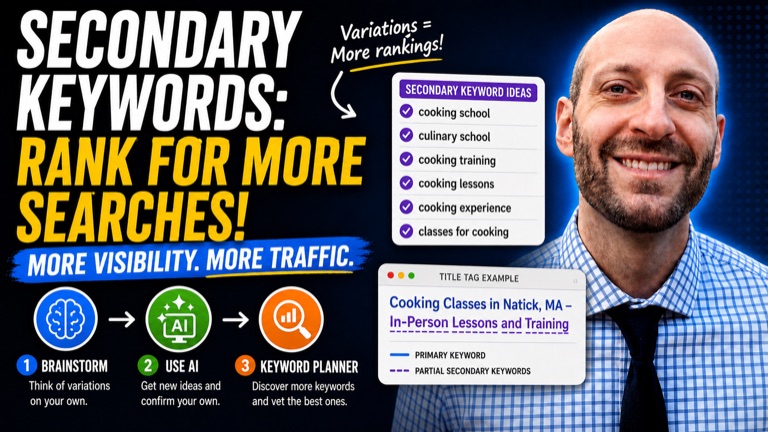
If "cooking classes" is our primary keyword, what are the variations we could build off of it? Here are some: cooking school, culinary school, cooking training, cooking lessons, cooking experience, classes for cooking. There are all kinds of variations that could exist, and it's a good idea to use them.
Remember the big four from last time: you use the primary keyword in the URL, the title tag, the H1, and the first paragraph. Once you've done that, you've pretty well established the primary keyword. Then it's time to start using variations, so that Google can match your page to all the different ways people might search for what you offer.
Where to Use Secondary Keywords
I suggest using them in the second half of the title tag, in subheadings, and in body paragraphs. There are other areas where you can use keywords too, like images, but I want to keep today's lesson simple. We'll cover images and other fields in the future.
How to Come Up With Them
This workflow looks a lot like the one for finding a primary keyword:
- Brainstorm variations on your own. Look at your primary keyword and think of the different ways people might search for it.
- Work with an AI. I love using Gemini in Chrome because it's so convenient, but Claude or ChatGPT work too. Give it the full context: here's the page I'm working on, here's some info about it, here's my primary keyword, and now I need some secondary variations. You'll get new ideas and confirm some of your own.
- Use Google's Keyword Planner. It's free to sign up for (if you have trouble, search "how to sign up for Google Keyword Planner free").
In Keyword Planner, go to Tools, then Keyword Planner, and this time choose Discover new keywords. Type in your primary keyword, "cooking class" or "cooking classes," it doesn't really matter. Notice I dropped the locality and didn't include Natick, MA. That's because of the tool's own guidance: try not to be too specific or too general. "Cooking class" is enough to help the tool understand what I want variations of. I'll also drop in Helen's URL, then click Get results.
Now I can see my primary keyword plus a list of keyword ideas. "Cooking school" is a fantastic variation. "Kitchen cooking," not so much, at least in my opinion, and this is where human discretion comes in. Don't just accept everything a tool gives you.
"Culinary school" is a pretty good one, but I wasn't sure at first. I thought it might surface more established schools or colleges, so I verified it: I searched "culinary school Natick, MA" in Google to make sure it's relevant to Helen's business. Sure enough, she shows up number one in the map pack and number one in the organic results, so it's a no-brainer, I'll use it. That's basically what I did, going down the line and vetting each keyword. You can also check the competition column and make sure everything is medium or low. As we decided in a previous lesson, we steer clear of high-competition keywords unless you're a well-established brand.
Two Ways to Use Them: Full or Partial
So now we have all these great keyword ideas. What do we do with them? Like I said, use them in the title tag, subheadings, or body paragraphs. But here's a cool technique.
One way is to use the full keyword, obviously, like "cooking school." Another is to use just part of the keyword, so you don't sound too repetitive. Say your title tag already reads "Cooking Classes in Natick, MA," and then you come in with "cooking training." It doesn't read all that well. So I'd drop the "cooking" and just use "training." We've got plenty of great words for that: training, lessons, experience. Since it's already obvious the page is about cooking classes, the keyword is almost implied, so you don't have to repeat the whole thing. If you did, the page would turn out spammy and wouldn't read well.
I want to teach you to be a tasteful SEO who creates content that reads well, so know that this technique is available. Here's it applied in the title tag: "Cooking Classes in Natick, MA - In-Person Lessons and Training." The primary keyword leads, and "lessons" and "training" are partial secondary keywords worked in naturally. That's a great title tag.
Seeing It on the Page
Let's see things in action on the page. We have the title tag above, the primary keyword in the eyebrow (from last lesson), and some great audience copy in the primary heading. So where do the secondary keywords come in?
- First paragraph: the primary keyword, which is part of our big four.
- Subheading: "More than a cooking school," using the variation a little deeper on the page.
- Body paragraph: "Helen's began as a small culinary school and grew into..." so we naturally fit in another variation.
- Echo of the title tag: "in-person lessons and real training," using the partial secondary keywords in an organic way.
- Another subheading: "cooking experience" and "classes for cooking."
You get the idea. We're getting these in well, and it all still reads naturally.
Final Thoughts
That's your lesson on secondary keywords, the variations on your primary keyword. I've given you three ways to come up with ideas (brainstorm, AI, Keyword Planner), three places to use them (title tag, subheadings, body paragraphs), and two techniques for using them: the full keyword, or just the partial keyword when you want to be a little more tasteful.
If you have any questions, leave me a comment and I'd be happy to help. I'll see you in the next lesson.