There's a lot of talk right now about complicated concepts like keyword universes, query fan-outs, and vector embeddings. Those things can be great, but I want to keep this simple.
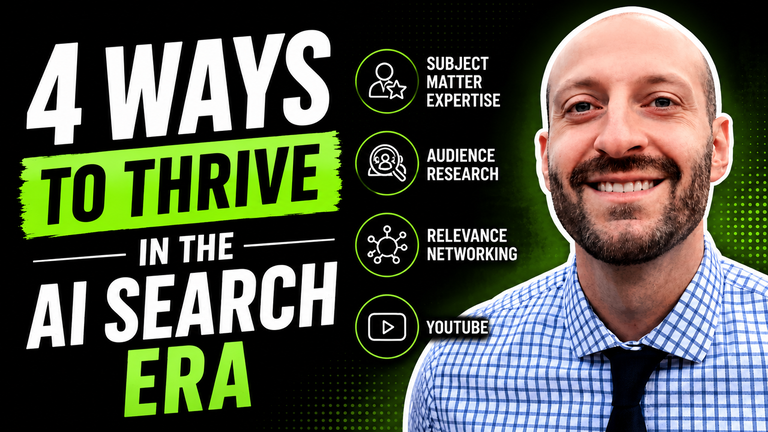
Here are four areas to focus on over the next twelve to twenty-four months if you want real success with AI visibility: subject matter expertise, audience research, relevance networking, and YouTube. You can watch the full breakdown below, or read on.
1. Lean Hard Into Subject Matter Expertise
I'm starting here because I've been having so much success with it. When AI writing started becoming common, I naturally rejected it. It seemed insulting to the people who would actually read the content, and I had a feeling search engines wouldn't love it either.
So I leaned into expert-led content instead. The format is simple: schedule a fifteen to thirty minute expert interview once a month. That's it. From that small block of time, you get a ton of material to work with.
You can use it two ways. Add color to content that already exists to bolster your current pages, or build entirely new pages around it.
My one rule: go nearly verbatim with what you get, whether it's a live interview or a written questionnaire. I'll pass the answers through an AI for light cleanup, but I deliberately tell it not to change much. I don't want AI writing here. That's the whole point of the exercise.
This stuff performs incredibly well. My clients are getting pulled into AI Overviews, cited in ChatGPT, and ranking in the traditional listings too.
Tip: If you can, capture the interview on video. I record with Google Meet because people are comfortable with it, and it sends you the file afterward. Load that into a tool like Descript or CapCut and you've got long-form and short-form video, plus a transcript you can turn into a blog post or a LinkedIn post. From fifteen minutes, you can do a lot.
2. Take Audience Research Much Deeper
This includes keyword research, but keyword research is a smaller piece of a much bigger exercise. This is where SEOs really need to push into new territory.
One thing we've learned from the longer, conversational queries people use on AI platforms is that they're complicated. A single query often hits several audience needs at once, sometimes in combinations you wouldn't expect. So you have to max out the empathy and go deep on what your audience is actually asking, what worries them, and what myths and misconceptions they hold.
Here's where to mine for those gaps:
- Client conversations. They know their audience. Ask about it in your kickoff and beyond.
- Sales team feedback. They know the questions, the objections, and how to overcome them, which is gold for your copywriters.
- SparkToro. A treasure trove built for audience research: the sites your audience visits, podcasts they hear, channels they watch, keywords they search, and the AI platforms and prompts they use.
- Reddit. A fantastic place for audience insights. Add .json to any subreddit thread URL to see every comment, reply, and upvote. I wrote a whole post on the Reddit .json trick.
- Your own data. Social listening, internal call transcripts, and the forms that come in from interested customers.
Keyword research still lives under this umbrella, and so does prompt research. SparkToro can hand you real prompts to work from. You can also open Google Search Console and look for queries of, say, ten words or more.
You can even connect Search Console to Claude through an MCP and let it do the digging for you.
Go through my GSC data and find me queries you can reasonably confirm are conversational, then show me those.
One more layer: query fan-outs, the related questions an AI engine spins off from your original prompt. The friendliest way to see them is Perplexity, which just reveals them to you. If you're more technical, you can watch ChatGPT's fan-outs in Chrome's inspector on the Network tab.
3. Treat Outreach as Relevance Networking
We all know link building outreach. I'm not saying abandon it. This is more of a mindset change, and that switch alone has gotten me better results.
I've started thinking about outreach as networking. If I'm on a service like Qwoted thinking like an outreach specialist, I'm just blasting journalists with my best responses. Fine. But the networking mindset makes it personal. I'm friendlier and more casual, and I invite follow-ups far more often, because I'm trying to connect with the person.
More often than not, the journalist responds. Sometimes we hop on a call, and a relationship starts to form. Whether or not I land that first placement, they're more likely to think of me for the next article. That's the networking paying off.
There's also a lesser-known SparkToro feature for finding genuinely relevant third-party sites that might link to or mention you. I covered it in a separate video. It leads to real back-and-forth over email, and I've had a lot of luck building ongoing relationships with publications relevant to my clients. We get cited, and we end up in their Rolodex for future opportunities.
4. Build Your Presence on YouTube
If you saw the recent Guardian article, YouTube just overtook Netflix for average daily viewing. So if you think your potential customers aren't on YouTube, you're wrong. They're absolutely there. It's a massive search engine, second only to Google.
It's time for SEOs to learn YouTube, and it is a different game. You'll have to prepare yourself through learning and experimentation, and you'll have to prepare your clients too, because getting them on video regularly is its own challenge.
Making it easy on clients is the most important and most overlooked part. The monthly SME interview is one path. For a local business, it can be as simple as turning on the camera at a job site and capturing thirty seconds of footage. I even heard a tip at SMX Advanced in Boston this year about using a pair of Meta glasses, which might be easier than a phone.
A few other things you'll need to learn to talk through with clients:
- Timelines. We're used to telling clients a website takes three to six or six to twelve months. YouTube is different and can take up to two years, so have case studies and the right language ready.
- Optimization. A different game, but honestly not too bad once you learn the baseline best practices and keep up with the trends.
- Audience growth. You have to engage and listen far more than you would with a website.
- Lead tracking and attribution. So you can account for the effort and show the value of your work.
My best advice: treat it the way we treat websites. The single best thing you can do, better than any course, is start your own channel. Post, experiment, and learn what works firsthand. You can do that right alongside your client work. Clients come in at different stages anyway. I've had brand-new channels and ones with 100,000 subscribers, and both were valuable because the game shifts at each level.
The Bottom Line
Do these four things and you'll thrive in the AI search era. None of them require a vector embeddings degree. They reward depth, empathy, and showing up consistently.
The Four Focus Areas
- Make your content expert-led. A fifteen to thirty minute monthly interview, kept nearly verbatim, feeds pages, video, and social.
- Take audience research far deeper. Mine clients, sales teams, SparkToro, Reddit, GSC, and query fan-outs for the real questions people ask.
- Compel relevant third parties to cite you. Treat outreach as networking, not a numbers game.
- Build your presence on YouTube. Make it easy on clients, set timeline expectations, and learn by starting your own channel.
Do these four things and you'll do quite well in the coming years.