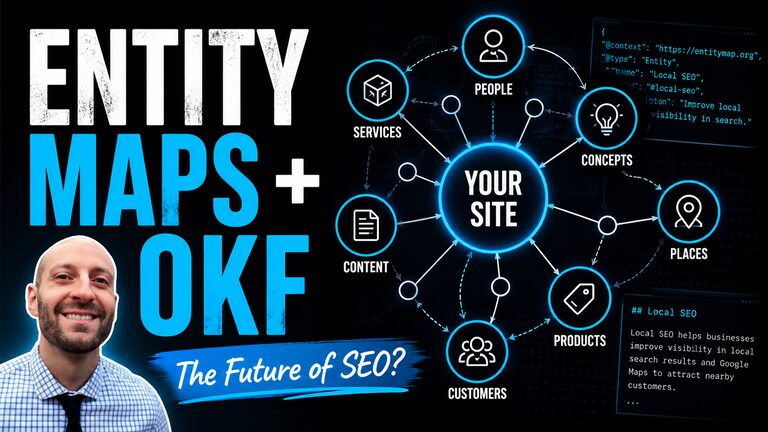
Today I want to talk to you about two protocols that I think have a lot of promise with SEO: entity maps and the Open Knowledge Format from Google. If there are a couple of forward-thinking things you want to focus on to stay on the leading edge, a couple of ideas that have a ton of promise, it's these ones.
I think you should learn about them. You should build them and test them, and see if they have a positive impact. But before we get into those, I want to reflect on a couple of topics that were hot-button issues in the SEO community that turned out to not show any promise just yet.
The ideas that haven't shown promise just yet
The first one is the llms.txt file. Ahrefs analyzed 137,000 websites, and 97% of the llms.txt files in that experiment never got read.[1]
Now, I don't have any issue with llms.txt files. I think they're pretty lightweight and easy to create, and there's no real downside to it. If you want to try one out, go ahead. But right now, there's really no proven benefit, at least not that I can see. I did see at least one counter study from Cyrus Shepard that showed an llms.txt file was getting hit by AI search platforms. It was getting visited and read, but as of now, no real measurable benefit. I don't see any case studies that are making this something we should all rush out and do.
The other one was markdown files, and to take that idea further, the thing being promoted was to create markdown versions of all your web pages. I saw this in a lot of different places. This has not panned out either. In fact, Google's John Mueller and Martin Splitt were on a podcast, and they said markdown duplicates of your pages give no SEO benefit, and crawlers do just fine with standard HTML.[2]
This one can actually be wasteful
Creating a markdown duplicate of every page means you've kind of doubled the representation of your website, and you've made more work for crawlers, for no measurable gain.
Entity maps: what this site knows, how it connects
What I want to talk to you about today is two ideas I think have way more potential. I love the direction these ones are going in. The first one is entity maps. This is a proposed protocol from the folks at Waikay, led by Grant Simmons.[3]
It's two files, and it charts the concepts on your site and how they relate. It goes beyond concepts, too: it can be people and services, ideas, topic areas, that kind of thing. It's going to map how they all relate to each other, and this is really good to help prevent hallucinations or inaccurate business descriptions by AI platforms.
It can ensure that when your content is cited in an AI output, you are referenced as the brand. A lot of brands were seeing that their content was being used in an output, but there was no mention of the brand anywhere, so it can help with that as well. And of course, it's very helpful in helping AI make relationships between certain things. So if one of your users has a prompt that intersects with two concepts on your website, it's going to help AI make that relationship and increase the likelihood that you're going to be part of that output.
It's not about taking your web pages and duplicating them in a file format. You've got to think about your website from a higher level than that.
"You're not just taking your web pages, duplicating them in a file format, and then calling that an entity map. You've got to think of your website from thirty thousand feet and map those entities."
Basically, think about it like two files: a JSON file and an HTML file, and they serve pretty much the same function. The HTML file is human-readable. You can see all the entities I worked out from my website and what each one represents. Like, Brian Gorman is a person, he's affiliated with the brand name, and then there's some evidence of that. And the service entities come in and show how all of that relates. By the way, I did an entire walkthrough of how to create an entity map for your site if you want to see the full process.
The Open Knowledge Format: the knowledge itself
Now the Open Knowledge Format is the knowledge itself. It's an open standard from Google, announced on June 12th of this year, and it's a shared format for representing what an organization knows. This is basically where you package what your business knows. This is your knowledge base.[4]
Try to keep track of the difference between an entity map and OKF, because that difference is important. The way I understand them, the two files can and should coexist, at least for now, because they serve two different purposes. Neither of these is a direct reflection of your website. It's not a duplicate of your web pages; it's a higher-level mapping than that.
We're dealing with markdown files here because it's easy for AI to ingest and interpret. These files are there so AI can access them and work through them as needed. It doesn't read all of them. It's kind of purpose-based, and it'll go to only the most relevant files. The files also have what you'd consider links or references to all the other knowledge files, so there's a kind of internal linking in an OKF setup, which is super interesting.
An analogy to keep the two straight
Think of a marketing agency that does local SEO. Here's how each one would speak:
- On the entity map: "I know about local SEO. Here's proof that I know about it, a little chunk from my website, and how it connects to me and other services, and customers and things like that."
- The OKF version: "Here's what I actually know about local SEO." That's very much evidence-based, and that's the knowledge itself.
And the OKF needs a way to be exposed to AI. One of the ways you can deliver your OKF and expose it to AI search systems is the llms.txt file. Now, I don't want to seem like a hypocrite for creating an llms.txt after questioning it earlier. I'm still not sure of the broader benefit, but this is a legitimate use for the file, and I'm going to test it. You might also be able to link it in your footer, and I'm going to test that too.
Tether them to your site, and keep them in sync
I am tethering these to changes on my website. Any time I make a change, like updating content or posting something new, I check in with that update and ask: is there anything relevant here that should end up as an update to my entity map and my OKF files? I think that's important, because as your site grows or shrinks, you might remove things too, and these files should be updated to represent that. Maybe not every update should change these files, but you should at least check in with it.
The other thing I've got running is keeping the two files in sync, because I want to avoid drift. I never want these to disagree and cause ambiguity, confusion, and thus hallucinations in AI outputs or understanding. That's another mechanism I've got going, and it's one of the big benefits of building these yourself: you're going to think of things like this.
The bottom line
That's what I wanted to talk to you about today: entity maps and OKF. I suggest you learn about them, build them yourself, experiment, and see if there's any positive impact. We need more people doing that to see if it has any legs, at least before it gets accepted as an official protocol, if it ever does.
I like these ideas. I think these have much more meat to them. It's very logical, it just makes a ton of sense, and I think there's a high probability that these do get adopted on a more official level in the future. So it's a chance for you to get ahead.
References
- Ahrefs. "We Analyzed 137K Sites for llms.txt: Here's What We Found." ahrefs.com.↩
- Search Engine Roundtable. "Google: Markdown Versions Of Your HTML Pages Don't Help With SEO." seroundtable.com.↩
- EntityMap. "EntityMap: Help AI Understand Your Site." entitymap.org.↩
- Google Cloud. "How the Open Knowledge Format can improve data sharing." cloud.google.com.↩