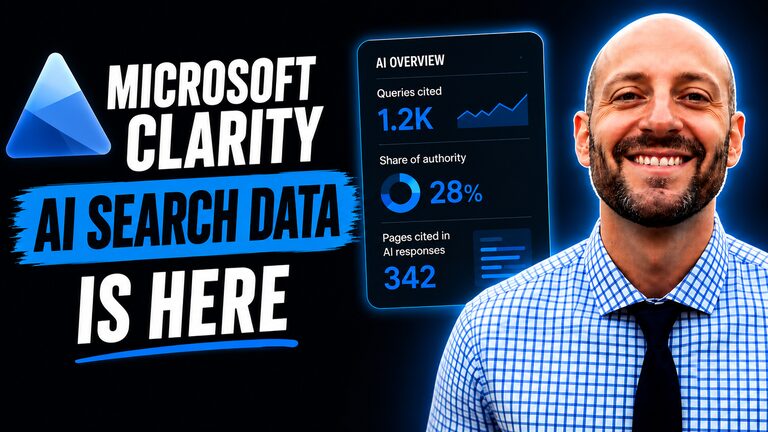
Today we're going to talk about Microsoft Clarity, because it's an incredible tool and they just made an amazing announcement. They're pulling AI search data into the tool and marrying it with the UX and user engagement data Clarity already gives you.
What Microsoft Clarity actually is
If you're not familiar with Clarity, it's a heat mapping tool. You can actually watch real recordings of people using your website. It's from Microsoft, it's a hundred percent free, and it's really easy to install.
Tip: If you don't have Clarity yet, get it. It's free, it installs in minutes, and the AI search data below is a reason to have it running now rather than later.
The announcement: AI search data comes into Clarity
The big announcement is that they're pulling AI search data into the tool and marrying it with the UX and user engagement data you already get from the heat maps and recordings. That's an unbelievable pairing, and this is real data from Microsoft and its partners.
The AI overview dashboard gives you a look at queries cited, your share of authority, some grounding queries, and even the pages that are cited in AI responses. An earlier announcement brought this AI search information into the tool. Today's announcement pushes it even further.
First-party data, not third-party
One of the first things Microsoft talks about in the announcement is the data itself, and this is Microsoft calling out other GEO tools. The first point they make is that this data is from Microsoft AI and select partner grounding, whereas other GEO tools use third-party data, and we know that can never compare to first party. From there, they lay out what makes it different:
- Real query-level data rather than estimates.
- Actual AI-generated citations, nothing synthetic, which third-party tools have to rely on.
- Integrated CDN-level data that gives you info on bot traffic (more on that later, because it's got some useful stuff too).
The full path from discovery to engagement
What's so cool about this tool is that now you can see the full path from discovery to engagement. Someone searches something within an AI platform, the assistant gives them an answer and cites your page, they click on it, and they visit your site.
You can see what they searched, what page got cited, and then when they clicked through, you can literally watch them interact with it.
All of that gives you actionable information, and that's one of the things I love the most about this announcement. It's highly actionable. Microsoft is telling you how to use the tool to make improvements to your site and to your strategy.
See where your brand is being cited
The first bit is seeing where your brand is being cited in AI responses. The data lets you compare how often your content is cited against competitors across Microsoft experiences. It's not Google data, but it's still really solid. From there, you can:
- Find the questions that trigger citations so you know what content to focus on next.
- Improve the pages that are cited most often to get more value from what's already working.
We know improving what's already working is always a great strategy. In fact, the way I typically start isn't even with SEO, it's with CRO. Improve what you already have, then look to build new assets.
Topics: rolling queries up to spot strengths and gaps
The second part of the announcement focuses on something called topics, and I want to lean in on this one because it's a fantastic update. It's rolling out gradually, so you might not see it in all your accounts right away, but you will in the near future.
I love looking at AI search queries this way. Rolling them up and aggregating them into topics lets you spot where a site is stronger or weaker, and that's exactly what this helps you do. In their example, they've clicked into the topic electric bicycles, and you get your competitive share and citation rate for it.
But if you scroll down further, the real gold is top content opportunities: the topic areas where you're weaker and not covering very well.
In the example, that's battery lifespan and replacement expectations for electric bicycles, a subtopic where you might need more content.
"It's important to know how AI is utilizing your content and how your brand is being represented in outputs."
On the right side it also gives you your top content to AI responses, so you can see how your top pages are contributing. Going back to the announcement, Microsoft frames the topic tool as turning AI citations into a competitive advantage: compare how often your content is cited against competitors, find the questions that bring up your content, and improve the pages that get cited most to drive bigger gains faster.
The only thing I'd add is that gap feature I called out as probably the best one. It helps you spot where you're weaker so you can create content and hopefully close some of the citation and authority gaps you have with competitors.
Which AI bots are crawling your site
The next part is really interesting: you can understand which AI bots are crawling your website. Here's what that gets you:
- See which bots visit your site and how often they show up.
- Tell the difference between crawling and search traffic so you know how your content is being picked up.
- Find the pages bots hit the most so you can focus fixes and improvements where they count.
That last one is my favorite. Microsoft is using your CDN and your log files to understand bot behavior on your site. In the tool you'll see your bot operators, like OpenAI, Anthropic, Meta, and Google, each with a percentage, plus the page paths and resources those bots are visiting.
Tip: Their deeper documentation points to a smart use for this. You can evaluate whether bot activity is actually contributing to downstream value. A bot might hit your site a ton, but when you check your other Clarity or analytics metrics, that AI platform may not be a real contributor to traffic, visibility, or leads.
An amazing update to an already amazing tool
All told, this is an incredible update to an already amazing tool. Clarity on its own, before any of the AI stuff, was already fantastic, and we use it at our agency regularly to watch people use our clients' websites and pull insights out of that exercise.
Now we have AI search data coming in too, giving us insight on how we're doing against competitors, which pages or topics to lean into, and what the bots are doing when they visit. It's great data to add to your strategies and your keyword research, with a ton of uses.
I love seeing Microsoft push the envelope on the kinds of AI data they're giving us, and honestly, they're outpacing Google on this one.
We've seen a lot of great updates in Bing Webmaster Tools, and to see it here in Clarity is awesome.
What to take away from this update
- It's first-party AI search data. Real query-level data and actual citations from Microsoft AI and its partners, not the third-party estimates other GEO tools rely on.
- You see the full path. What someone searched in an AI platform, which page got cited, and then a recording of them interacting with it once they clicked through.
- Topics show strengths and gaps. Roll queries up into topics to compare citation share against competitors, and use top content opportunities to find where you're weak and need content.
- Watch the bots, but judge the value. See which AI bots crawl you and how often, then check whether that activity actually drives traffic, visibility, or leads before you act on it.
- Get Clarity if you don't have it. It's free and easy to install, and this data is worth having running now.